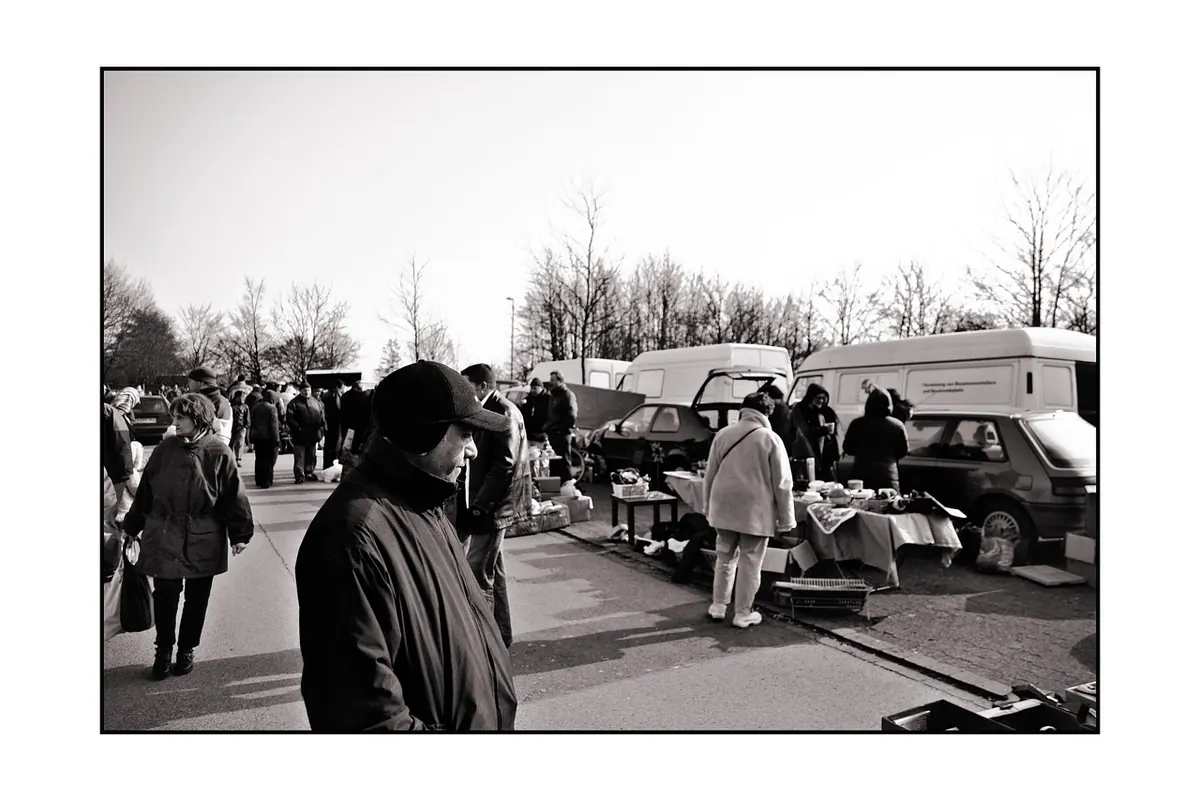
There is a particular sinking feeling that arrives the moment you turn a chest of drawers around and find a plywood back stapled into place. Reproductions have improved enormously, and the better ones look convincing in photographs, in a dim saleroom and at thirty paces across a fair. The checks below take a few minutes and cost nothing but a torch and a tape measure. Run them before money changes hands, not afterwards.
Wear Should Fall Where Hands Actually Go
Real wear is random, uneven and completely logical. A chest of drawers wears on the handles, along the front edges of the top, and on the runners the drawers slide over. Chair feet scuff where they meet the floor and lose their sharpness at the front corners. The top rail of a chair back is polished smooth by generations of hands, and a gateleg table's drop is worn at the edge you grip to lift it.
Faked wear is the opposite: too even, and in the wrong places. Sanding rounds every arris — the sharp edge where two surfaces meet — until the piece looks like a bar of soap, including edges nobody ever touched, such as the back edge of a tabletop. Watch for the gap between a worn-looking surface and an untouched one. If the drawer fronts are battered but the runners are pristine, or the feet are scuffed while the underside of the carcase is factory-clean, slow down and look again.
Patina Is Chemistry, Not a Colour
Wood changes with age. Oak darkens, mahogany deepens and then lightens where daylight falls on it, walnut settles into a warm grey-brown. Interior surfaces that were never polished usually stay noticeably paler than the outside. Decades of polishing build up a thin, translucent film of French polish that sits in the grain and in the corners of carving, and you can often see it in a moulding where a cloth never reached.
A reproduction is generally stained and finished uniformly, inside and out. Compare an exterior surface with the inside of a drawer, the underside of a top and the back of the carcase. If the colour runs consistently through places that never saw daylight or a polishing rag, you are almost certainly looking at a modern finish. Brass behaves similarly: old brass wears to a soft warm tone where hands touch it and darkens in the recesses, while new brass tends to look either uniformly bright or uniformly, evenly distressed.
If the Silhouette Is Wrong, Nothing Else Matters
Proportions are the hardest thing to fake and the easiest to check, provided you have done a little homework. Study the reference books, museum online collections and, best of all, the genuinely old furniture in your nearest museum. Then take a tape measure to the fair and note the details: seat heights, the taper of a leg, the depth of a drawer against its width, the thickness of a top, the sweep of a cabriole leg.
Copies tend to be a touch too tall, a little heavy in the leg and slightly too generous in the drawer. Period-style furniture made in the 1920s and 1930s can look entirely right in a photograph and strangely heavy in a room. Viewed from ten feet, the outline is what gives a piece away.
Get a Torch and Read the Tool Marks
Dating by construction is more reliable than dating by style, because tools leave evidence behind.
Dovetails
Hand-cut dovetails are made individually, so the pins and tails vary slightly in width and spacing, and the joints often carry faint saw marks inside. Machine-cut dovetails are perfectly regular, and frequently much narrower and more closely spaced.
Nails and Screws
As a rough guide, hand-wrought nails with irregular heads are early; machine-cut nails with rectangular shanks and off-centre heads point to the 19th century; round-headed wire nails became common towards the end of it. Hand-cut screws gave way to slotted machine screws during the 19th century, and Phillips-head screws belong firmly to the 20th. A piece claiming to be Georgian should contain none of them.
Saw Marks and Planing
Look under a tabletop or inside a carcase. Hand-planed surfaces show faint ripples and often a slight taper across the width of a board; machine-planed timber is flat and uniform. Circular saw marks indicate a later date than pit-sawn stock, and plywood, hardboard and MDF have no business in a piece described as 18th or early 19th century.
Look Where the Light Doesn't Reach
Turn the piece over. Take out a drawer and examine its bottom, its back, the runner and the inside of the carcase. Genuine age is consistent: the same timber, the same construction, the same softened edges throughout. Honest repairs are normal and nothing to fear — what matters is whether the whole thing was made last year. Run your hands over the interior. Old wood feels dry and faintly rough; new timber feels crisp. Smell helps too, since old furniture smells of wax, shellac and dust rather than fresh sawdust.
The Ten-Point Checklist
- Are the wear patterns random and logical, rather than sanded into every edge?
- Does the patina differ between exposed and hidden surfaces?
- Is the colour and figure of the timber consistent with its supposed age?
- Do the proportions match the period, checked against reference material?
- Are the dovetails hand-cut and slightly irregular?
- Are the nails and screws of types correct for the claimed date?
- Do the undersides show hand-planing and appropriate saw marks?
- Are the drawer bottoms, backs and carcase interiors made of old timber?
- Do the brass fittings, hinges and locks show believable age and wear?
- Does the seller's account match the evidence, with restoration declared?
Before You Hand Over the Money
Ask directly what has been restored or replaced, and request clear close-up photographs of the drawer bottoms, screw heads, feet and back. A confident dealer will send them without complaint. If a piece is sold as genuinely old, ask for the condition and any restoration to be confirmed in writing on the receipt.
Budget for repairs before you commit, and never let auction fever or a closing-time discount talk you into a decision you would not make in daylight. If the sum involved is significant, a furniture restorer or a dealer specialising in the period will usually give an honest opinion for a modest fee, and that is money well spent. For anything valuable enough to insure, take proper advice on valuation and cover before you move it.
And if you love a piece that turns out to be a reproduction, buy it anyway — happily, and at a reproduction price.
Photo: Tama66 / Pixabay